From The $100 Startup · Part I, Chapter 1
Renaissance
"The need for change bulldozed a road down the center of my mind."
— Maya Angelou
A box, a layoff, and a tandem bike
On a Monday morning in May 2009, Michael Hanna put on a Nordstrom suit with a colorful tie and drove to his office in downtown Portland. Twenty-five years in corporate sales. Meetings, pitches, email all day. One of the morning's messages was from his boss, asking to see him that afternoon.
When Michael walked into the office and sat down, his boss didn't make eye contact. "After that," Michael told me, "everything happened in slow motion. I had heard story after story of this experience from other people, but I was always disconnected from it. I never thought it could happen to me."
His boss mentioned the downturn in the economy and the unavoidable need to lose good people. An HR manager appeared out of nowhere, walked Michael to his desk, and handed him a cardboard box — an actual box — for his things. He drove home at 2:30 to figure out how to tell his wife.
A few months later, a friend who owned a furniture store mentioned that he had a truckload of closeout mattresses and no use for them. "You could probably sell these things one at a time on Craigslist and do pretty well," the friend said. The job search wasn't going anywhere. Michael called his wife. "Honey, it's a long story, but is it OK if I buy a bunch of mattresses?"
He needed somewhere to put them. He found a car dealership that had recently gone out of business and convinced the landlord to let him temporarily set up shop in the old showroom. The first inventory moved through Craigslist and word of mouth. He had no business plan and no real knowledge of mattresses, but he knew he wanted a place where customers weren't hassled.
He studied up, negotiated with the landlord to stay, and built a website with his wife. The store offered the industry's first-ever mattress delivery by bicycle — a friend built a custom tandem bike with a platform on the back that could carry a king-size mattress. Customers who rode their own bikes to the store got free delivery. YouTube videos started showing up.
Two years later, Michael was looking through his closet and noticed the Nordstrom suit. He hadn't worn it once in two years. He carried it out on his bike, dropped it at Goodwill, and continued on to the mattress store. "It's been an amazing two years since I lost my job," he says now. "I went from corporate guy to mattress deliveryman, and I've never been happier."
Welcome to the strange new world
Around the same time Michael was opening his accidental mattress shop, a first-time entrepreneur named Sarah Young was opening a yarn store across town. Asked why she took the plunge at the bottom of the recession with no business experience, Sarah said: "It's not that I had no experience. I just had a different kind of experience. I wasn't an entrepreneur before, but I was a shopper. I knew what I wanted and it didn't exist, so I built it."
In England, Susannah Conway started teaching photography classes for fun and made more money than she did as a journalist. When I asked her what she didn't foresee when starting up, she said: "I didn't know I was starting up!"
Benny Lewis graduated with an engineering degree in Ireland, never used it, and now travels the world as a "professional language hacker." When I asked if there was anything else I should know about his business, he wrote back: "Yes. Stop calling it a business! I'm having the time of my life."
Welcome to the strange new world of micro-entrepreneurship. In this world, Indian bloggers earn $200,000 a year teaching Excel. Roaming, independent publishers run their operations from Buenos Aires and Bangkok. One-person businesses pull off $100,000 product launches and trigger nervous bank-manager calls when the deposits clear.
Many of these unusual businesses grow by giving things away — recruiting fans and followers who support paid work whenever it's offered. "My marketing plan is strategic giving," said Megan Hunt, who makes hand-crafted dresses and wedding accessories from Omaha and ships them around the world.
Microbusinesses aren't new — what's new is the speed
Solo merchants have been around since the start of commerce. The Grateful Dead built a community of fans and made their money on tickets and merchandise instead of records — in 1967. None of that is the new thing.
What's new is how fast someone can go from idea to revenue. Going from concept to operational business can take under a month and cost under $100. The handyman who used to put up flyers at the grocery store now advertises through Google to people searching for "kitchen cabinet installation" in their city. The scale, reach, and connection have changed even if the underlying impulse hasn't.
This is a middle-class, leaderless movement. Ordinary people are opting out of traditional employment and making their own way — usually without much training, and almost always without much money. Most of the founders in the study didn't go to business school. More than half had no prior business experience. Several dropped out of college; others never went.
The $100 Startup model — and the study behind it
I had access to a wide circle of microbusiness case studies through my work as a writer. To go beyond what I already knew, I cast a wide net: a Google form that grew into thousands of data points, interviews on a 63-city North American book tour, hundreds of follow-up emails, phone calls, video calls, and in-person meetings in fifteen cities around the world.
When I closed the nomination process, I had more than 1,500 respondents to choose from. All of them met at least four of these six criteria:
- Follow-your-passion model. A business built around a hobby or activity they cared about.
- Low startup cost. Under $1,000 in startup capital — especially those that cost almost nothing (less than $100) to begin.
- At least $50,000 a year in net income. Profitable businesses that earned at least as much as the average North American income.
- No special skills. Businesses that ordinary people could operate — not dentistry, but the kind of thing you could learn on the job.
- Full financial disclosure. Willing to share actual revenue and expense figures, not generalities.
- Fewer than five employees. Deliberately small. Many of the case studies are strictly one-person operations.
About half the stories come from the United States; half from the rest of the world. The baseline test for what made the book: "Could you explain what you do to your grandmother, and would you be willing to?"
Three lessons from the study
From the 1,500 stories, three lessons kept showing up. The rest of the book is built on these.
Lesson 1: Convergence
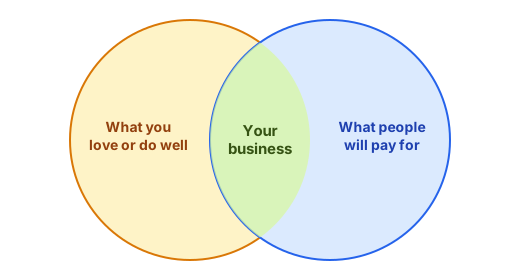
Convergence is the overlap between what you care about (or are good at) and what other people are willing to spend money on. Two circles. Inside the overlap is where a microbusiness can thrive.
Not everything you're passionate about is interesting to the rest of the world. Not everything you're good at is marketable. I can be passionate about eating pizza, but nobody is going to pay me to do it. Convergence is what separates a hobby from a business.
Lesson 2: Skill transformation
You're probably good at more than one thing — and the skills from one context can transfer into another.
Kat Alder was waitressing in London when someone said, "You'd be really good at PR." She didn't know much about public relations — wasn't even sure what the letters stood for — but she knew she was a good waitress. Always got good tips. Made customers happy by recommending menu items she was confident they'd like.
After a temporary BBC job ended, she thought back on the conversation, landed her first client within a month, and figured the rest out. Four years later her firm employed five people across London, Berlin, New York, and China. Same people skills. Different application.
The lesson generalizes: teachers have communication, adaptability, crowd control, lesson planning, and coordination across competing interest groups. Parents have negotiation. Waiters and bartenders read rooms. None of those is a job title — they're all transferable raw material.
Scott Adams, the creator of Dilbert, put it this way:
I succeeded as a cartoonist with negligible art talent, some basic writing skills, an ordinary sense of humor and a bit of experience in the business world. The "Dilbert" comic is a combination of all four skills. The world has plenty of better artists, smarter writers, funnier humorists and more experienced business people. The rare part is that each of those modest skills is collected in one person. That's how value is created.
Lesson 3: The magic formula
Take the first two ideas together and you get the not-so-secret recipe:
Passion or Skill + Usefulness = Success
Jaden Hair built a career around Steamy Kitchen — a recipe site and food publishing business that grew out of a $200 investment. Cookbooks, TV offers, and corporate sponsorships followed. She's good at cooking and good at sharing what she knows. People want both. Convergence + usefulness.
Brandon Pearce was a piano teacher who built scheduling and billing software for himself. Other music teachers wanted it. He turned it into Music Teacher's Helper and now earns more than $30,000 a month. He lives in Costa Rica when he isn't traveling. Same recipe.
The three things every business needs
The basics of starting a business are simple. No MBA (save the $60,000), no venture capital, no detailed plan. Three things:
- A product or service. What you sell.
- People willing to pay for it. Your customers.
- A way to get paid. How you exchange the thing for money.
If you have interested people but nothing to sell, you don't have a business. If you have something to sell but no one willing to buy, you don't have a business. And without a clear, easy way for customers to pay, you don't have a business either. Put all three together and congratulations — you're now an entrepreneur.
Everything else is optional. You can add an offer (what we'll cover in Chapter 7), a launch (Chapter 8), a hustling strategy (Chapter 9), and a system for growth (Chapter 11). But the three things above are the bones.
The decision matters more than the plan
From his home base in Seattle, James Kirk used to build and manage computer data centers around the country. Then, in an act of conviction that took less than six months from idea to execution, he packed up a 2006 Mustang and drove to South Carolina to start an authentic coffee shop in the land of biscuits and iced tea.
"There was one moment very early on where I realized, this is what I want to do, and this is what I am going to do. And that was that. Decision made. I'll figure the rest out."
A few months later, Jamestown Coffee opened for business in Lexington, South Carolina. James and his new staff had worked ten-hour days for weeks to prepare. The mayor came to cut the ribbon. A line of customers stood waiting to sample the wares.
James went on to make a real plan once the doors were open. But the more important step came first: the decision to begin.
Key takeaways
- Microbusinesses aren't new — but the speed is. Going from idea to revenue can take under a month and cost under $100. That part is genuinely different.
- Three things make a business. A product or service, people willing to pay for it, and a way to get paid. Everything else is optional.
- If you're good at one thing, you're probably good at others. Skill transformation is the most under-used resource most would-be founders have.
- The magic formula. Merge your passion or skill with something useful to other people. The convergence in the middle is the business.
- The decision matters more than the plan. Plenty of people in the study made their plan after they made the leap, not before.
One thing to try this week. List ten things you're good at — not job titles, actual skills. Then list ten things you care about. Look for the overlap. Pick one combination and ask yourself: "Who already pays for this somewhere, and could I do it for them differently?" That question is the doorway to a business.
Where this fits in the book
"Renaissance" is the opening chapter of The $100 Startup and the entry point for everything that follows. The three lessons here — convergence, skill transformation, and the magic formula — recur throughout the rest of the book.
Chapter 2 (Give Them the Fish) builds on these by asking what people actually want when they pay for your product. Chapter 3 (Follow Your Passion... Maybe) complicates the passion side of the formula — not every passion is monetizable, and some of the best businesses come from related skills you didn't realize you had.
Frequently asked questions
What are the only three things you need to start a business?
A product or service to sell, a group of people willing to pay for it, and a way to get paid. That's the entire list. Not an MBA, not venture capital, not a detailed business plan. Put those three together and you have a business.
What is convergence?
The overlap between what you care about (or are good at) and what other people will pay for. Two circles. Inside the overlap is where a microbusiness can thrive. Convergence is the foundation principle of the book and recurs throughout.
What is skill transformation?
The realization that you're probably good at more than one thing — and that skills from one context can transfer into another. Kat Alder, a waitress in London, applied her ability to read people into a PR career that grew to five people across four countries.
Who was studied for The $100 Startup?
More than 1,500 founders, all of whom met at least four of six criteria: they followed a passion, had a low startup cost (under $1,000), earned at least $50,000 a year, didn't need specialized degrees, were willing to disclose their finances, and operated with fewer than five employees. About half from the United States, half from the rest of the world.
Where does this fit in The $100 Startup?
Chapter 1, the opening chapter of Part I (Unexpected Entrepreneurs). It introduces the world of micro-entrepreneurship, the 1,500-person study, and the three core lessons the rest of the book builds on.
Get more
Your First Sale — 14 days from idea to first sale
Day-by-day workbook with 12 fillable worksheets. One task per day, 30–60 minutes. Starts at $29.
See what's includedGet the free $100 Startup resource library
The one-page business plan, the marketing plan, the launch checklist, and three more. All from the book. All free.