Key Lessons from The $100 Startup
On a Monday morning in May 2009, Michael Hanna put on a Nordstrom suit with a colorful tie and drove to his office in downtown Portland. Twenty-five years in corporate sales. Meetings, pitches, email all day. Then his boss asked to see him that afternoon, wouldn't make eye contact, and an HR manager appeared out of nowhere with a cardboard box.
A few months later, with nothing happening on the job front, a friend mentioned he had a truckload of closeout mattresses and no use for them. Michael called his wife: "Honey, it's a long story, but is it OK if I buy a bunch of mattresses?"
He found an empty car dealership to use as a showroom. Mary Ruth built a website. A friend constructed a custom tandem bicycle that could haul a king-sized mattress on the back. "I had no business plan and no knowledge of mattresses," Michael said. Two years later, he spotted the Nordstrom suit in his closet. He hadn't worn it once. He dropped it at Goodwill and kept going. "I went from corporate guy to mattress deliveryman, and I've never been happier."
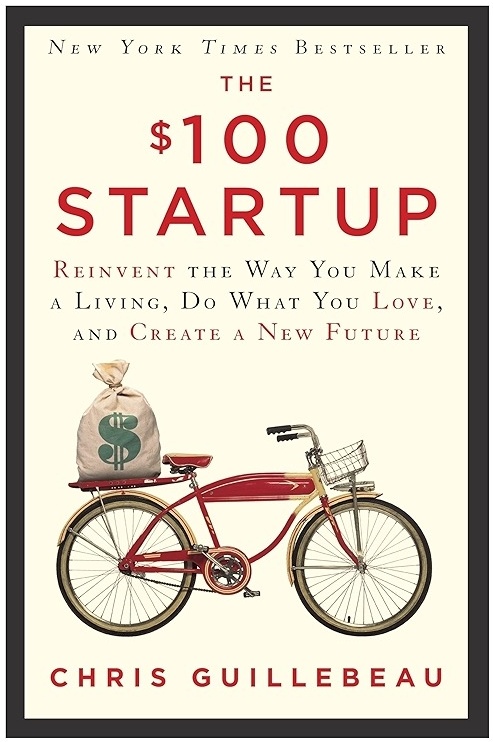
Michael's story is one of more than 1,500 I collected for The $100 Startup. The qualifying criteria were strict: at least $50,000 a year in net income, less than $1,000 in startup costs, no special skills required, fewer than five employees. The median startup cost across the entire study was under $100.
Here are the lessons that actually mattered, drawn straight from the research. Real names, real numbers, and the patterns I kept seeing over and over.
Freedom and value
The book has two themes. Freedom is what we're all looking for. Value is the way to get it.
There's no rehab program for being addicted to freedom. Once you've seen what it's like on the other side, good luck trying to follow someone else's rules ever again.
Building a business that gives you freedom requires three things: a product or service, people willing to pay for it, and a way to get paid. That's it. Everything else is optional. Important, maybe, but optional.
Two circles, not three
This is the most important concept in the book, and it's the one people get wrong most often.
Convergence isn't about finding the overlap between three things. It's two circles. Circle one: something you especially like to do or are good at (preferably both). Circle two: something other people care about enough to spend money on. The overlap between those two is where a business lives.
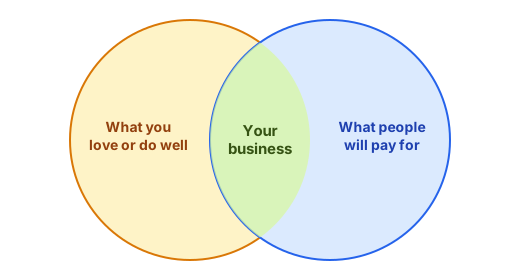
That second circle is what separates a business from a hobby. I can be passionate about eating pizza, but nobody's going to pay me to do it. Passion without usefulness is fine if what you want is a hobby. But if you want income and freedom, both circles have to overlap.
Brett Kelly wrote an in-depth guide to Evernote. He was good at the software, genuinely loved productivity tools, and thousands of people were willing to pay $25 for a guide that saved them hours of figuring it out themselves. He earned over $120,000 from a PDF. Eventually that number passed $160,000. His wife quit her restaurant job.
Jaden Hair started Steamy Kitchen with $200. She merged her love of cooking with something genuinely useful: easy, healthy recipes that families could actually make on a weeknight. That convergence led to cookbooks, TV offers, and corporate sponsorships. When I met her at an event in Austin, I could barely get through the crowd to say hi.
If you're stuck at the beginning, start here. What do you enjoy or know how to do? Who would pay for that? Every business on this list sits in that overlap.
You're good at more than you think
This surprised me more than anything else in the research. Many of the businesses were started by people with related skills, not the exact skill their business ended up requiring.
Kat Alder was waitressing in London when someone told her, "You know, you'd be really good at P.R." She didn't know anything about P.R. Wasn't even sure it stood for Public Relations. But she was a great waitress. Good tips, happy customers, always knew what to recommend from the menu. After getting let go from a temporary gig at the BBC, she thought back on that conversation. She still didn't know much about the industry, but she landed her first client within a month and figured the rest out as she went. Four years later, her firm employed five people and operated in London, Berlin, New York, and China.
The skills she used as a waitress—reading people, making recommendations, building rapport—transferred directly into P.R. She didn't need a whole new profession. She needed to see that what she already knew was applicable somewhere else.
"I succeeded as a cartoonist with negligible art talent, some basic writing skills, an ordinary sense of humor and a bit of experience in the business world. The Dilbert comic is a combination of all four skills. The world has plenty of better artists, smarter writers, funnier humorists and more experienced business people. The rare part is that each of those modest skills is collected in one person. That's how value is created."—Scott Adams
You don't need to be the best in the world at any one thing. You need a useful combination.
Give them the fish
"Catch a man a fish, and you can sell it to him. Teach a man to fish, and you ruin a wonderful business opportunity."—attributed to Karl Marx
Picture this. It's Friday night, you head to a nice restaurant after a long week. You order the salmon risotto. Then the chef comes out and says, "Risotto is tricky... wash up and meet me in the kitchen."
That would be insane. You didn't come to learn to make risotto. You came because you work all week and want someone to take care of everything. Most customers don't want to learn how to fish. They want the fish.
This changes how you think about what you sell. You're not selling a process or a list of features. You're selling a result people want but don't want to produce themselves.
Go deeper: Read the full Chapter 2 treatment — the V6 Ranch story, Higher Ground Yoga, Purna's $200K Excel business, and three strategies for selling what people actually buy.
John and Barbara Varian built furniture on a ranch in Parkfield, California. Population: 18. After a fire destroyed their inventory, they pivoted to hosting riding groups on 20,000 acres between LA and San Francisco. I asked Barbara what they sell. "We're not selling horse rides," she said. "We're offering freedom. Our work helps our guests escape, even if just for a moment in time, and be someone they may have never even considered before."
Horse rides are a feature. Freedom is a benefit. Nobody pays $200 a night for an animal to carry them around. They're paying to feel like a cowboy for a weekend.
In India, Purna Duggirala teaches people to use Microsoft Excel. Not the sexiest business in the world. But his net income hit $136,000, on track for $200,000. His framing says everything: "Our training programs make customers a hero in front of their bosses or colleagues." He's not selling spreadsheet lessons. He's selling promotions and respect.
Kelly Newsome left a $240,000-a-year Manhattan law job to start Higher Ground Yoga in Washington, D.C. She focused on a specific market: busy women executives, aged 30-45, often with young children. She built the practice past $50,000, then on track for more than $85,000. "One time when I was a lawyer, having just worked with an outstanding massage therapist, I said to her, 'It must be so great to make people so happy.' And it is."
If you can describe your business in terms of how it changes your customer's life, you'll outsell anyone who's still listing features.
The formula
I spent a long time trying to distill what I found across 1,500 case studies into something simple. Here it is:
Passion or skill + usefulness = success
Not complicated. But people ignore half of it constantly. They chase passion without usefulness, or they do useful work they hate until they burn out. The businesses that lasted had both sides covered. Every time.
Start now
A 40-page business plan gives you the illusion of progress without any actual progress. The people in the study didn't write business plans. They wrote offers. They found customers. They figured things out by doing them.
Sarah Young opened a yarn store at the height of the recession. "It's not that I had no experience; I just had a different kind of experience. I wasn't an entrepreneur before, but I was a shopper. I knew what I wanted and it didn't exist, so I built it." Profitable within six months.
Benny Lewis graduated with an engineering degree from a university in Ireland and never used it. He calls himself a "professional language hacker," traveling the world helping students learn languages quickly. When I asked if there was anything else we should know about his business, he said: "Yes. Stop calling it a business! I'm having the time of my life."
None of these people asked for permission. Michael didn't get a mattress certification. Sarah didn't study retail management. Benny didn't earn a teaching credential. They had skills useful to other people, and they started. Remember: the median startup cost was under $100. The barrier isn't money. It's the decision to begin.
Here's what it takes. Six steps from the book:
- Decide on your product or service.
- Set up a website, even a very basic one.
- Develop an offer. (An offer is different from a product. It's the product plus the case for why someone should buy it now.)
- Set up a way to get paid. PayPal works fine to start.
- Announce your offer to the world.
- Learn from steps 1 through 5, then repeat.
If you want to make those six steps concrete, the one-page business plan takes about 15 minutes and forces you to answer the questions that matter. Not 30 pages of projections. One page. Then go.
Frequently asked questions
Is The $100 Startup still relevant?
More than ever. The cost of starting has dropped even further since the book came out in 2012. The tools are better and cheaper. But the core ideas—convergence, skill transformation, giving people the fish—aren't time-sensitive. They're about how people make decisions and what makes a business work. That doesn't change.
What's the difference between convergence and following your passion?
Convergence requires two circles, not one. You can be passionate about eating pizza, but nobody's paying you to do it. The second circle—what other people want enough to spend money on—is what turns passion into income. Without it, you've got a hobby.
Do I need special skills or a degree?
No. The study criteria specifically excluded businesses that required specialized training. Kat Alder didn't know P.R. stood for Public Relations when she started her firm. Michael Hanna knew nothing about mattresses. What they had was the willingness to start and figure things out as they went.
What's the first step after reading this?
Fill out the one-page business plan. Takes about 15 minutes. Forces you to answer what you're selling, who's buying, how you get paid. If you don't have an idea yet, browse the list of $100 businesses and pick one that fits what you already know how to do. Then test it.
What is The $100 Startup about?
The book is a practical playbook for starting a microbusiness for under $100, published in 2012 and built around a three-year study of more than 1,500 founders who launched for under $1,000 and grew past $50,000 a year with fewer than five employees. The core ideas — convergence, skill transformation, the one-page business plan, and "give them the fish" — come directly from what those founders did. Over a million copies sold worldwide.
What are the main takeaways from The $100 Startup?
Three: convergence (the overlap between what you care about and what other people will pay for), skill transformation (taking what you already do well in one context and applying it in another), and "give them the fish" (don't teach customers how to do something — solve the problem for them). On top of those three, the book argues that the real barrier isn't money or skills. It's the decision to begin. The 1,500-person study showed an average startup cost of $610, and many founders launched for under $100.
Get more
Your First Sale — 14 days from idea to first sale
Day-by-day workbook with 12 fillable worksheets. One task per day, 30–60 minutes. Starts at $29.
See what's includedGet the free $100 Startup resource library
The one-page business plan, launch checklists, and promotion plan templates from the book. All free.