The One-Page Business Plan
Jen Adrion and Omar Noory graduated from the Columbus College of Art and Design in 2008. They both started freelancing as designers. Just one year after graduation, the feeling of burnout from commercial design was inescapable. "Should I have gone to med school?" Jen wondered. "What if accounting would have been a better fit?"
On a drive back from Chicago, they talked about other things—an upcoming trip to New York, places they hoped to visit. When they got home, Omar looked around for a nice map to help chart their adventures. They couldn't find one they loved, so they decided to make their own. They stayed up late at night, working on their ideal map while talking about all the places they hoped to go.
One problem: the printer had a minimum order of 50 units for $500. A lot to spend when you only need one map. But the project had come to mean more than just a print. Jen and Omar each put down $250. They loved the result, hung one on the wall, gave a few to friends... and still had forty-four maps with no obvious purpose.
Omar had a crazy idea. Would anyone want to buy the remaining prints?
They made a one-page website, added a PayPal button, and went to bed. The next morning, they woke up to their first sale. Then another. A popular design forum picked up their work, and they sold out the entire first print run in ten minutes.
Nine months later, both of them had quit their day jobs. "It's funny, because we're both obsessive planners," Jen told me. "But this project had almost no planning whatsoever in the beginning, and now it's our full-time work."
$500 total investment. No business plan. No market research. No competitive analysis. Just a product they wanted to exist, a PayPal button, and the willingness to ship it.
Why one page (and not zero, and not thirty)
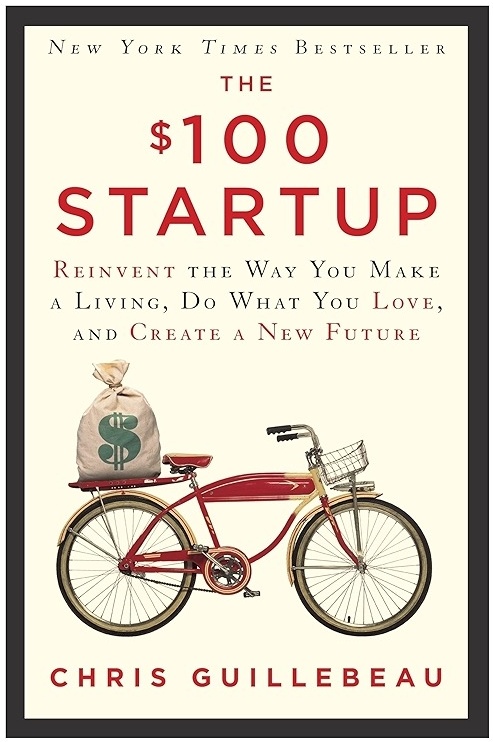
In the battle between planning and action, action wins. Many of the case studies in The $100 Startup reported a similar pattern to Jen and Omar's—get started quickly and see what happens.
But "no plan" doesn't mean "no thinking." It means you don't need 80 pages that nobody will ever read. Most small business plan templates copy the SBA's nine-section outline — executive summary, company description, market analysis, organization, product line, marketing, funding request, financial projections, appendix. For a micro-business, most of that is theater. You need enough clarity to take the first step. One page forces that clarity without letting you hide.
Every business, at its core, has three requirements: a product or service, people willing to pay for it, and a way to get paid. That's it. A one-page plan just makes sure you've thought through each piece—and a couple of others—before you start. It won't take you a month. It should take you an hour.
And consider the startup costs from the study: Jen and Omar started for $500. Amy Turn Sharp in Columbus started a handcrafted toy company for $300. Nicolas Luff in Vancouver started with $56.33—the cost of a business license. Michael Trainer in New York launched a documentary business for $2,500 (the cost of a camera he later sold for a profit). When the investment is that low, you don't need a financial model. You need a page.
The template (all 5 sections)
This is the one-page business plan from The $100 Startup. Five sections. One or two sentences per question. That's the whole thing. If you're writing paragraphs, you're overthinking it.
Section 1: Overview
What will you sell?
Who will buy it?
How will your business idea help people?
This is your foundation. If you can't describe what you sell in a sentence, you don't have enough clarity yet—and that's fine, but it means you need to think more before you build more.
"Who will buy it" should be a specific person, not a demographic. Not "health-conscious millennials." Think: who's the first actual human being who'll hand you money? What's their situation? What are they struggling with?
"How will it help people" is where folks go vague. Don't. Remember the lesson from Chapter 2: give them the fish. What changes in their life? What problem goes away? Be concrete.
Section 2: Ka-Ching
What will you charge?
How will you get paid?
How else will you make money from this project?
A real number. Not "I'll figure out pricing later." Later never comes, and when it does, you'll underprice out of fear.
"How will you get paid" is more practical than it sounds. PayPal? Stripe? Cash at a farmer's market? Don't leave this blank. Jen and Omar used a PayPal button on a one-page website. That was enough.
The third question—how else will you make money—is where you think about upsells, related products, or services that branch off your main offer. You don't need an answer right now. But it's worth having on your radar from day one.
Section 3: Hustling
How will customers learn about your business?
How can you encourage referrals?
This is the section that matters most and the one people fill in worst. "Social media" isn't an answer. "Word of mouth" isn't a strategy. How, specifically, will the first 10 people discover that you exist?
Jen and Omar got lucky with a design forum mention. You might not. Will you post in specific online communities? Reach out directly to people who fit your customer profile? Partner with someone who already has the audience you want? Get specific here. This is the section to spend the most time on.
And referrals: what would make a customer tell a friend? A product so good they can't help talking about it? A discount for sending someone your way? Build this in from the start, not as an afterthought.
Section 4: Success
The project will be successful when it achieves these metrics:
Number of customers ______ or Annual net income ______ (or other metric you choose)
Pick a number. Not a fantasy number. A "this would make the effort worth it" number. Maybe it's 50 customers. Maybe it's $2,000 a month in net income. Maybe it's replacing your freelance income so you can quit. Whatever it is, write it down. A business without a success metric is a hobby with expenses.
Section 5: Obstacles / challenges / open questions
Specific concern or question: _______________
Proposed solution: _______________
Deadline: I will launch this project into the world no later than _________.
What could go wrong? What don't you know yet? What's the thing that keeps nagging at you when you think about actually launching?
Write it down. Then write a proposed solution. You don't need all the answers—you just need to acknowledge the questions and have a rough idea of how you'd handle them. The act of writing it down takes a vague anxiety and turns it into a solvable problem.
And notice the last line: a deadline. Not "someday." A date. That line is there because the biggest obstacle for most people isn't money or skills or the market. It's the decision to actually begin.
The 140-character mission statement
Before you fill in the template, try this exercise. Write your mission statement in 140 characters or fewer. (Yes, the old Twitter limit. The constraint still works.)
We help [customers] do/achieve [primary benefit].
That's it. If you can fill in those two blanks clearly, you understand your business. If you can't, you're not ready for the template yet—and that's useful information too.
Some examples from the book. If you have a dog-walking service, the feature is "I walk dogs." The benefit is "I help busy owners feel at ease about their dogs when they're not able to be with them." If you make custom wedding stationery, you might say: "I help couples feel special about their big day by providing them with amazing invitations."
This isn't a marketing exercise. It's a clarity exercise. Your mission statement won't appear on your website or your business cards. It's for you. It tells you, in one line, why your business exists and who it's for.
The components of a business plan (and where they live on one page)
If you've ever read an SBA template or a Bplans article, you've seen the standard list: nine components — executive summary, company description, market analysis, organization and management, product or service line, marketing and sales, funding request, financial projections, and appendix. That outline was built for someone borrowing $250,000 from a bank. It wasn't built for someone starting with $300 and a domain name.
The good news: you don't have to throw any of those components out. They each live somewhere on the one-page version. The list below maps the traditional small business plan outline to where each component shows up here.
Executive summary → your 140-character mission statement
Company description → Section 1 (Overview)
Market analysis → Section 1 ("who will buy it") and Section 3 (Hustling)
Product or service line → Section 1 ("what you sell")
Marketing and sales → Section 3 (Hustling) plus a referrals line
Pricing and revenue model → Section 2 (Ka-Ching)
Goals and success metrics → Section 4 (Success)
Risks and open questions → Section 5 (Obstacles)
Launch deadline → bottom of Section 5
Financial projections → a back-of-envelope number you'll see in the next section
Same components. A fraction of the words. If a banker or grant officer ever asks for the long version, you have enough thinking on one page to expand it in an afternoon. If they don't, you've saved an afternoon.
The mini executive summary (when you don't have an executive)
A traditional executive summary is the first page an investor reads. For a micro-business owner, the only executive is you, and the only person reading it is also you. So it doesn't need to be long. It needs to be true.
Two sentences. Fill in these blanks:
[Business name] helps [specific audience] do/achieve [primary outcome] by offering [your product or service]. We launched in [date], reach customers through [primary channel], and aim to reach [revenue or customer target] by [date].
Here's a worked example of an executive summary in a business plan for a micro-business — Jen and Omar's map company in its first six months:
These Are Things helps design-minded travelers plan and remember the places they've been by selling hand-drawn art prints of cities and regions. We launched in 2009, sell directly through our website and a small handful of design retailers, and aim to reach $5,000 per month in net revenue by the end of our first year.
Two sentences. Everything an executive summary needs to do — what you sell, who it's for, how you reach them, what success looks like — handled in the time it takes to write a text message. If someone needs the longer version, write it. If they don't, you've finished your executive summary.
The financial plan (when there's almost nothing to finance)
The standard financial plan asks for three-year projections, cash-flow models, and a breakeven analysis. For a business that costs $300 to start and sells to other humans, those projections are fiction with formatting. The model has no real information in it. It's a guess in a spreadsheet.
Here's what a financial plan for a small business plan actually needs to show:
- Startup costs — one number, the total you'll spend before your first sale.
- Monthly fixed expenses — hosting, tools, any recurring cost. Another single number.
- Price per unit and units to sell per month — what you charge times how many you need to move to cover those fixed expenses plus a profit you'd be glad to take home.
- Your "half" plan — one line about what you'll do if revenue is half what you hope. Cut expenses? Add a channel? Take longer to grow?
If you can fit those four pieces on an index card, your financial plan is done. The case studies in the book are full of founders who started with $28, $56, $80. None of them built a spreadsheet model. They priced their offer, found a way to get paid, and tracked the numbers as they came in.
Market before manufacturing
Here's a story that changed how I think about launching.
A friend of mine created an information product aimed at the high-end car industry. He offered a specialty guide that sold for $900—except he didn't actually create it before he advertised it in a magazine. He knew it would be a lot of work to put the guide together, so why do the work if no one wanted it?
Partly to his surprise, he received two orders. The cost of the ad was just $300, so that represented $1,500 in profit—if he could actually create the guide. He wrote to the two buyers and said he was developing a "new-and-improved, 2.0 version," and he'd love to send it to them at no additional charge as long as they could wait thirty days. Both buyers chose to wait. He spent the next month frantically writing the guide, then sent it to the eagerly-waiting customers. Since he knew he had a success on his hands (and it helped that he actually had a product now), he placed another ad and sold ten more.
The lesson: prove demand before you build. Don't spend months creating something nobody wants. Find out if people will pay first. Then do the work. If you want to go deeper on this, read the full guide on testing your business idea.
The first sale changes everything
In Louisville, Kentucky, I talked with Nick Gatens about a small photography project he'd been working on. "I'm not sure I've got the right site design, or the right message for visitors," he told me.
I was curious, so I flipped open my laptop and asked for the URL. "Well," said Nick. "I don't actually have the site up yet."
I didn't have to say anything. Nick stared down at his coffee cup, in realization of the obvious. The other people we were hanging out with encouraged him too, and he left determined to make progress.
A few weeks later, I saw Nick again. This time he had an excited look on his face: "I got the site up, and I made a sale!" A stranger had followed a link from somewhere on the internet and paid $50 for a print.
"That conversation made me think about why the site wasn't up yet," Nick said. "In my head, it was all technical: I had to tweak the design and fix some errors in the code. But being honest with myself, I realized my fear was still holding me back; the technical stuff was just an excuse."
$50. One sale. From a stranger. That's all it took to turn a side project into something real. Once the first sale came in, Nick knew he'd succeed. It may not have been completely rational, but that single sale motivated him to take the business much more seriously.
If you've filled in this template but haven't made a single sale yet, here's how to launch.
Frequently asked questions
Can I really run a business with just a one-page plan?
For a micro-business, it's all you need. Jen and Omar started their map business with zero plan and $500. Nick Gatens launched a photography print business over a weekend. A one-page plan is more than most of them had. If you're raising venture capital or hiring 50 people, sure, you'll need more. But that's a different game entirely.
What's the most important section?
Hustling—how customers will find out you exist. You can have a great product and fair pricing, but if nobody knows about it, nothing happens. Most people fill in the other sections easily and leave Hustling blank or vague. That's the section to spend the most time on. Figure out how your first 10 customers will discover you.
How often should I update it?
Whenever something meaningful changes—you shift your audience, change your pricing, discover a better way to reach people. There's no set schedule. The whole point of keeping it to one page is that it stays alive. It's a working document, not a filing cabinet artifact.
Is this the same template from the book?
Yes. The five sections—Overview, Ka-Ching, Hustling, Success, and Obstacles—come directly from The $100 Startup and the companion PDF. The framework is the one from the book.
What are the components of a business plan in this template?
The traditional nine components — executive summary, company description, market analysis, organization, product line, marketing and sales, funding request, financial projections, and appendix — all map onto the one-page version. The five sections plus the 140-character mission statement and a back-of-envelope financial plan cover the same ground in a fraction of the words.
Do I need an executive summary in a one-page business plan?
Yes, but a two-sentence one. The 140-character mission statement is the heart of it. The mini executive summary section above shows the fill-in-the-blanks version: "[Business] helps [audience] do [outcome] by offering [product]. We launched in [date], reach customers through [channel], and aim to reach [target] by [date]." That's everything an executive summary needs to do at micro-business scale.
What about the financial plan?
Four lines is enough: startup costs, monthly fixed expenses, price per unit and units to sell per month, and a "what I do if revenue is half what I hope" line. If you can fit it on an index card, you're done. The case studies in the book are full of founders who started with $28, $56, or $80 — none of them built a three-year spreadsheet model.
Get more
Your First Sale — 14 days from idea to first sale
Day-by-day workbook with 12 fillable worksheets. One task per day, 30–60 minutes. Starts at $29.
See what's includedGet the free $100 Startup resource library
The one-page business plan template, launch checklists, and promotion plan templates from the book. All free.