The $100 Marketing Plan
Your marketing plan shouldn’t cost more than your marketing budget.
The tactical playbook for solo entrepreneurs, side hustlers, and micro-business owners who need to get the word out—without lighting money on fire figuring out what Meta’s algorithm wants this week.
The problem
It’s 9pm on a Tuesday. You just finished the actual work of your business—the client deliverable, the product order, the thing you’re good at. And now you’re staring at your phone thinking I should really post something.
So you open Instagram. You stare at the blank caption box. You look at what other people in your space are posting. You feel behind. You close the app. You tell yourself you’ll figure out marketing this weekend.
You won’t. Not because you’re lazy—because nobody gave you a plan.
You’re stuck in the posting loop
Open app. Stare at blank caption. Look at what everyone else is posting. Feel behind. Close app. Repeat next Tuesday.
You tried paid ads and got nothing
You spent $300 over two months, got eleven likes and something called “ThruPlays.” Meta took your money and sent a cheerful notification suggesting you spend more.
You’re drowning in advice
Build an email list. Create valuable content. Be consistent. Great advice. None of it is a plan. It’s a to-do list with no priorities, no sequence, no sense of what matters at your scale.
You’re frozen before you’ve started
You’ve got the idea. Maybe even the product. But every time you think about “marketing,” your brain serves up a wall—website, social, email list, ads, SEO—and you freeze.
Here’s what changed
Meta and Google figured out that small businesses will keep spending even when the ads don’t work—because what else are you going to do?
Organic reach has been in free fall for years. Email deliverability got harder. Google’s AI overviews are swallowing the search traffic that used to go to small websites.
Meanwhile, the marketing advice industry is booming.
Courses for $997. Masterminds for $5,000. Gurus who haven’t run a real business since 2019 telling you to “just provide value.” An entire ecosystem built on making you feel behind so you’ll buy the next fix.
So many small business owners are genuinely discouraged right now.
The work of building something—the product, the service, the thing you actually care about—that part you can do. But the marketing feels rigged. The platforms take your money and shrug. The free advice is either obvious or contradictory. It’s demoralizing.
The rules did change. But they didn’t change the way you think.
The things that actually drive customers to small businesses—trust, clarity, word of mouth, genuine relationships—those got more powerful, not less. In a world full of AI-generated content and algorithmic noise, the fact that you’re a real person building a real thing is a competitive advantage that no big company can touch.
You don’t need to become a marketer. You don’t need to go viral. You need a plan that fits your actual life, works at your actual budget, and focuses on things that are genuinely in your control.
That’s what this is.
The plan that fits your actual life and your actual budget.
Get the $100 Marketing PlanWhat this is
It’s an 80-page reference guide with a set of companion tools. You buy it, you open it, you use what you need. Some people will read cover to cover. Most will jump to the chapter that matches where they’re stuck. Every chapter stands on its own.
The guide covers 11 chapters across three parts: getting your foundations right (who you’re talking to, what you’re saying), choosing and using channels that work at your scale (email, content, paid ads, partnerships, your website), and building the system that keeps it running without eating your life.
But what makes this different from another marketing PDF is what comes with it.
What comes with it
The tools are where
the work happens.
Most businesses don’t have a marketing problem. They have a message problem—they can’t clearly say what they do, for whom, and why it matters. The guide explains it. The tools fix it.
Every tool in this list ships with the guide. No extra purchases, no premium tier.
The Guide
The $100
Marketing Plan
$100
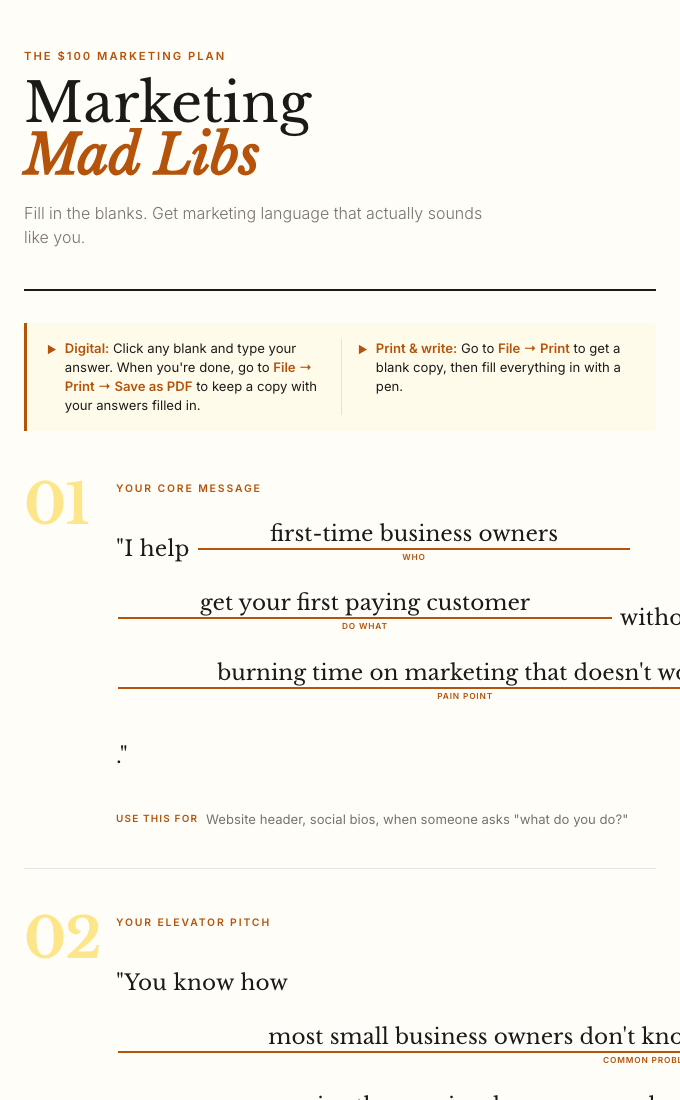
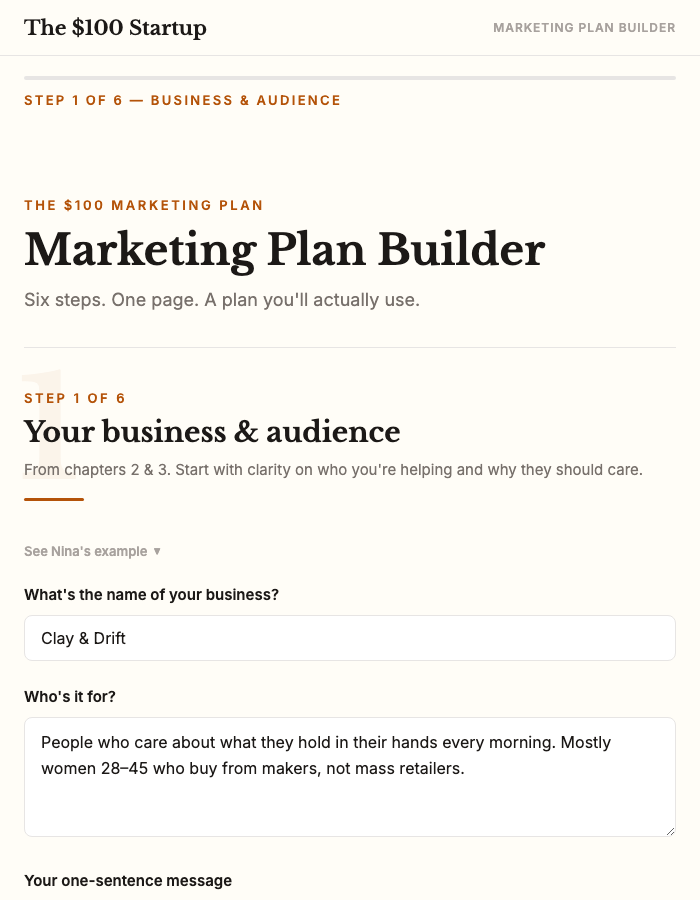
Fill in simple blanks. Get your one-sentence pitch, homepage headline, social bio, email subject formulas, and a word-for-word referral script. Six exercises. No staring at a blank page.
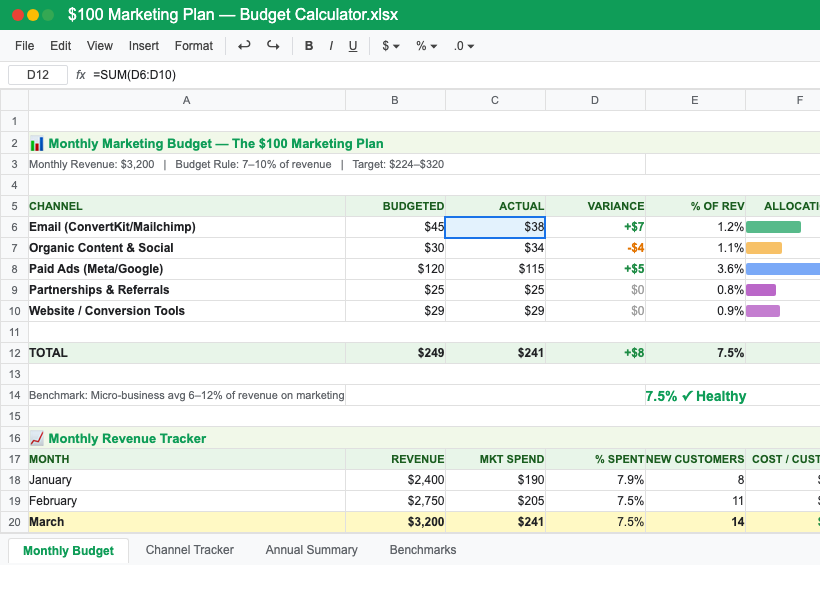
Divide your budget across channels. Track whether it’s working month over month. Benchmarks calibrated for micro-businesses—not startups burning venture capital.
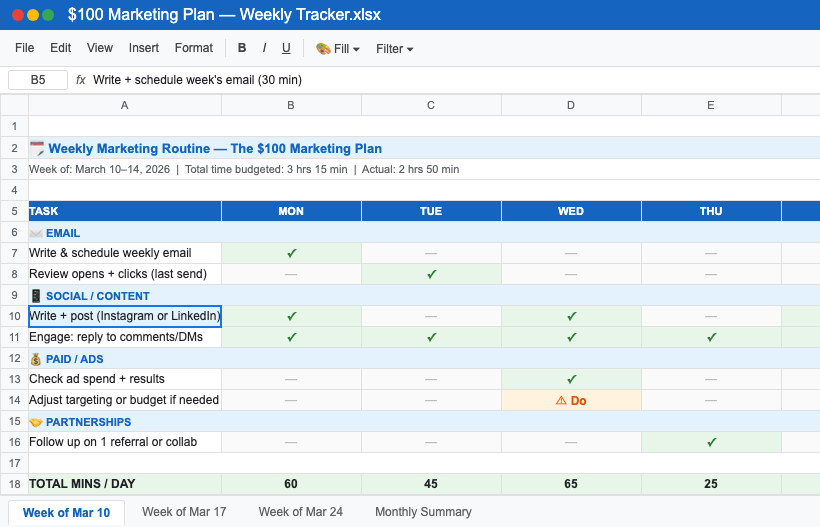
Turns “I should be doing more marketing” into a specific routine—which tasks, which days, how long each takes. Marketing becomes an hour on Tuesday, not a guilt spiral you carry all week.
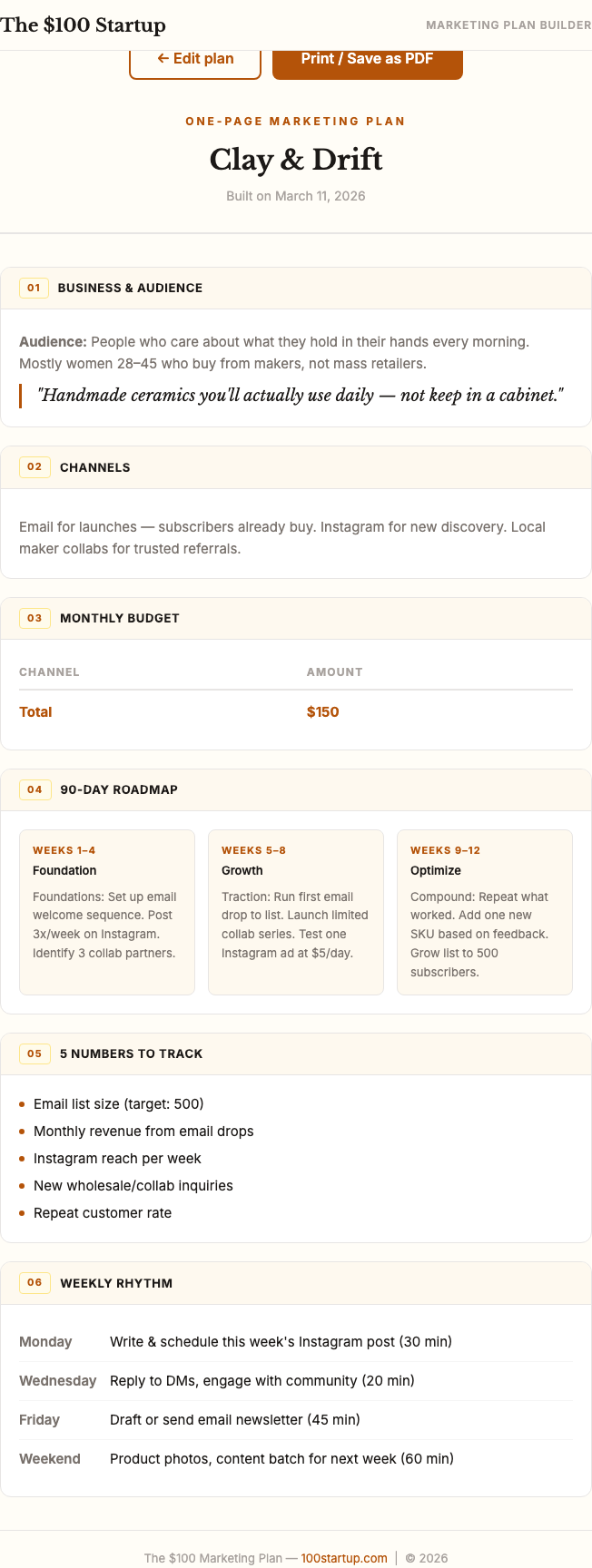
A phased roadmap: what to focus on in weeks 1–4, 5–8, and 9–12, with milestones that tell you whether to keep going or change course.
Real emails, social posts, and landing pages—annotated so you can see why they work, not just that they do. Steal the structure, adapt it to your business.
Use AI tools to speed up your marketing without sounding like a robot wrote your business. Copy-paste prompts calibrated for small business voice and specificity.
Absorb the ideas on a walk instead of at a screen. The full guide in audio—so you can learn without adding another task to your desk.
The tools are where the work happens.
Most businesses don’t have a marketing problem. They have a message problem—they can’t clearly say what they do, for whom, and why it matters. Marketing Mad Libs fixes that in about fifteen minutes.
Try it right now.
Fill in the blanks above to see your pitch.
That’s one of six exercises in the full Mad Libs toolkit. The complete version also generates your elevator pitch, your homepage headline, your social media bio, email subject line formulas, and a word-for-word referral script you can text to someone today.
See what you should actually be spending.
The full Budget Calculator goes deeper. It helps you divide your budget across channels, tracks whether it’s working month over month, and includes benchmarks calibrated for micro-businesses—not startups burning venture capital.
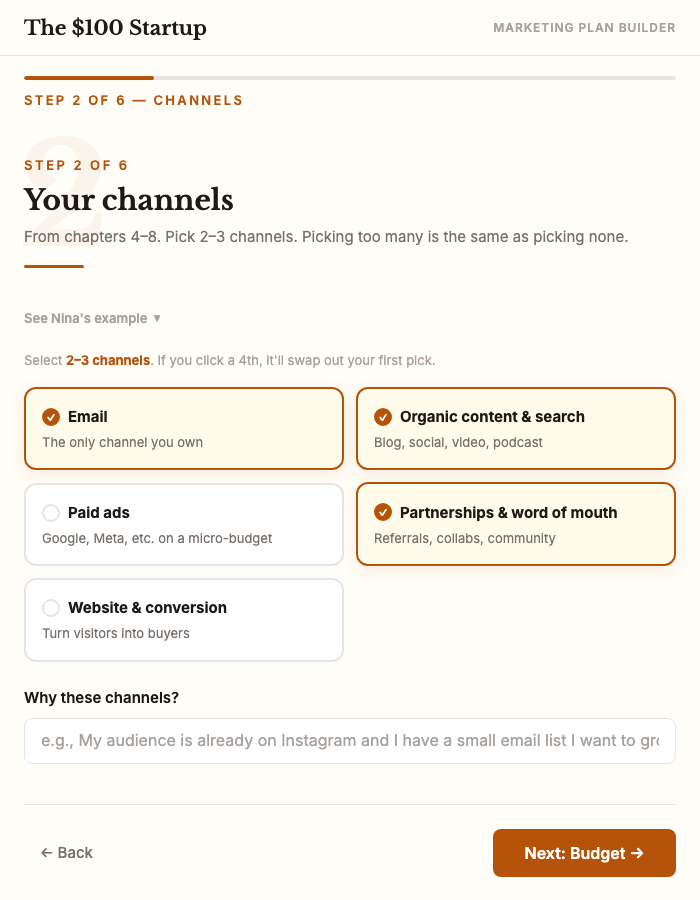
Pick your channels.
The Weekly Marketing Tracker takes “I should be doing more marketing” and turns it into a specific routine—which tasks, which days, how long each one takes. Marketing becomes something you do for an hour on Tuesday, not a guilt spiral you carry around all week.
The 90-Day Plan Builder pulls it all together into a phased roadmap: what to focus on in weeks 1–4, 5–8, and 9–12, with milestones that tell you whether to keep going or change course.
There’s also a Swipe File of real examples—actual emails, social posts, and landing pages, annotated so you can see why they work. An AI Prompt Library for using AI tools to speed up your marketing without sounding like a robot wrote your business. And an audio companion so you can absorb the ideas on a walk instead of at a screen.
What’s inside
Act 1: Foundations
Before you pick a channel or spend a dollar, get these three things right.
Act 2: The channels
Five chapters. Five ways to reach people. Pick the ones that fit and skip the rest.
Act 3: The system
Marketing only works if you keep doing it. These three chapters make that sustainable.
From the book that started it all
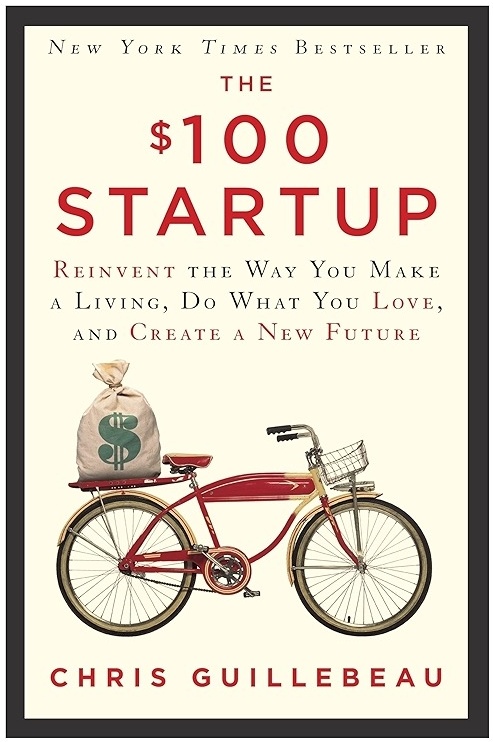
The $100 Startup has sold over a million copies worldwide. The idea at its core—find the intersection of what you love and what people will pay for, launch fast, iterate—hasn’t changed. It’s still the playbook.
What changed is the world you’re marketing in. The algorithms. The tools. Where attention goes and how trust gets built. The $100 Marketing Plan picks up where the book’s marketing chapters leave off and brings them into the world as it actually works right now.
If you’ve read the book, you’ll recognize the philosophy. If you haven’t, this stands on its own.
It’s the next step on the same path: the free resource library gives you frameworks, Your First Sale walks you through your first 14 days, and The $100 Marketing Plan gives you the system to keep growing from there.
Who this is for
This is for you if:
- You run a business mostly by yourself—or you’re building one
- Your marketing budget is measured in hundreds, not thousands (or it’s zero and you want to know where to start)
- You know you should be marketing but you don’t have a system for it
- You’d rather have a clear plan you can execute in a few hours a week than another course that takes longer to watch than your actual workday
- You’re already selling and need to sell more, or you’re getting ready to launch and want to start right
Probably not for you if:
- You already have a marketing person or team
- You want someone to do it for you
- You’re looking for a shortcut that replaces the work
- You need enterprise-level strategy—this is built for businesses of one to five, not fifty
$100.
The guide. The tools. The templates. The swipe file. The audio. All of it.
No tiers. No upsells. No “premium” version where the useful parts are locked behind another paywall.
The price is the point: this teaches you to market your business on roughly $100 a month. It costs what it teaches you to spend.
The offer
One price. No tiers. No upsells.
$100.
One-time purchase. Keep it forever.
The price is the point: this teaches you to market your business on roughly $100 a month. It costs what it teaches you to spend.
11 chapters, 3 acts—read cover to cover or jump to what you need
6 exercises—pitch, headline, bio, subject lines, referral script
Spreadsheet with monthly tracking and micro-business benchmarks
Specific tasks, specific days—marketing as a routine, not a guilt spiral
Phased roadmap with milestones for weeks 1–4, 5–8, and 9–12
Real emails, posts, and pages—with notes explaining why they work
Copy-paste AI prompts, plus the full guide in audio
Frequently asked questions
I haven’t started my business yet. Is this too advanced for me?
No. If you’re close to launching (or figuring out what to launch), the Foundations section will help you clarify your message and audience before you spend a dollar. You’ll be ahead of most people who launch first and figure out marketing later.
I already read The $100 Startup. Do I need this?
The book gives you the strategy for building a micro-business. This is the tactical marketing playbook—updated for how channels, algorithms, and tools work now. They’re complementary, not redundant.
Will this work for my type of business?
If you sell a product or service to other humans and your marketing budget is under $500/month, yes. The examples span service businesses, product businesses, digital products, consulting, and creative work.
What if I have literally zero marketing budget right now?
Several chapters focus on channels that cost nothing but time—organic content, partnerships, referrals, email on free-tier tools. The Budget Calculator helps you figure out what you can spend, even if the answer is $50/month. You don’t need a big budget. You need a clear plan for the budget you have.
How is this different from all the free marketing advice online?
Free advice tends to be either too generic (“post consistently!”) or too tied to one platform. This is a complete system designed for your scale—connecting your message, your channels, your budget, and your weekly routine into something that holds together. The companion tools mean you’re doing the work as you go, not just reading about it.
P.S. You already know what happens if you don’t do this. You keep posting when you remember to. You keep spending money on ads that don’t convert. You keep meaning to “figure out marketing” next month. And next month comes and goes.
The businesses that grow aren’t the ones with the biggest budgets. They’re the ones that stopped winging it and started working a plan. Even a basic plan beats no plan—every time.
This one costs $100. It’ll take you a weekend to read and a week to implement. And you’ll have a system you can use for the next year.
The best time to start marketing was when you launched. The second best time is this week.